
For thirty years, the relationship between Europe and the Gulf ran on autopilot:Europe bought hydrocarbons, the Gulf bought machinery, and everyone attended the same conferences. That era ended twice. It ended first by degrees, as war on Europe’s eastern flank, the Gulf’s post-oil transformation, and the fragmentation of the global trading system turned a comfortable commercial habit into a strategic necessity, an admission formalised at the first EU-GCC summit in Brussels in October 2024. It ended a second time, abruptly, on 28 February 2026, when the United States and Israel struck Iran after nuclear negotiations collapsed, and Iran retaliated against its Arab neighbours and moved to close the Strait of Hormuz. China is the GCC’s largest trading partner; Washington is its security guarantor. Europe, for five months now, has been discovering in its energy bills what it means to be the partner whose corridors run through a war zone.
The headline numbers still describe the scale. EU-GCC trade in goods reached €165.7billion in 2025, according to the European Commission, making the EU the Gulf’s second-largest trading partner after China. Commission data for 2024 put the EU’s direct investment stock in the GCC at €163.1 billion and the GCC’s stock in the EU at €189.8 billion. What the aggregates could never show, and what the war has now made visible in real time, is that the relationship is not a single trade flow but a set of corridors, in energy, capital, industry, logistics, and institutions, each with its own logic and its own vulnerabilities. Follow the corridors, and both the damage and the opportunity become legible.
First, the shape of the stress test. From early March, Iran effectively closed the Strait of Hormuz, the channel that carried close to 20million barrels of oil per day before the conflict, roughly one fifth of global consumption. The International Energy Agency has described the result as the largest supply disruption in the history of the oil market; Brent peaked near $118 per barrel. A Pakistan-mediated ceasefire in April and a memorandum of understanding in June both failed to hold, and since early August a fragile pause has rested on Omani-mediated talks over a lasting transit regime for the strait. In late July the threat returned to the Bab al-Mandeb: Yemen’s Houthis, largely quiet since last October,resumed attacks and declared a blockade of Saudi-linked shipping, extending strikes north toward Yanbu, while a drone strike on a floating gas facility at Egypt’s Damietta carried the risk toward the Suez route and the Mediterranean. Two of the world’s great maritime choke points are impaired at once; the third sits within range.
Start with the corridor the war has tested most violently. Europe’s sharp reduction in Russian pipeline gas, down roughly 87 percent from 2021 levels to around 18billion cubic meters in 2025, had elevated long-term Gulf LNG relationships from a commodity question to a security question, anchored by Qatar’s fifteen-year supply agreements with Germany, whose first deliveries were scheduled to begin this year. Then Iranian drone attacks in early March forced Qatar Energy to halt production and declare force majeure, and missile strikes on 18 and 19 March damaged two liquefaction trains at the Ras Laffan complex,the world’s largest LNG export facility, taking roughly 17 percent of Qatar’s export capacity (about 12.8 million tonnes per year) offline for what the company estimates could be three to five years of repairs. Italy’s Edison alone has been notified that 24 cargoes, some3 billion cubic meters, will be withheld between April and the end of September. Even the tankers that do sail are exposed: two LNG carriers loaded in Qatar have been struck in the strait within a month, the latest at the end of July.
The European ledger is stark. The Commission calculates that the EU spent roughly €25billion more on oil and gas imports in the first 54 days of the war alone. Benchmark gas prices touched a three-and-a-half-year high in late July and remain about 70 percent above last summer’s levels; storage entered August at its lowest seasonal level since 2009, and the binding filling target for 1 November has been lowered from 90 to 80 percent. The policy response came quickly: an emergency Accelerate EU package of 44 measures to blunt the price shock and speed up electrification, deeper reliance on Atlantic LNG, and closer coordination with Gulf producers. Saudi Arabia pushed its East-West Pipeline to its maximum of 7 million barrels per day to move crude to the Red Sea coast, a workaround the Houthis began targeting at Yanbu this week. The lesson is not that long-term Gulf contracts failed; it is that contracts were never the whole corridor. Duration and predictability still matter, but they now require physical redundancy (routes that bypass straits, storage on both shores) and protection. EU leaders have said the bloc is ready to work with Gulf partners on precisely such infrastructure, and the hydrogen and ammonia chapter,suspended by the fighting, will return with routing designed in from the first drawing.
The second corridor has proved the most resilient, with one telling asymmetry. Gulf sovereign wealth funds, which manage roughly $5.7 trillion in aggregate assets according to the industry tracker Global SWF, committed a record $53.9billion across 108 deals in the first half of 2026, war not withstanding; Abu Dhabi’s Mubadala alone deployed $15.2 billion. Only the Qatar Investment Authority visibly slowed, cutting deployment by about $2billion per quarter in a direct reflection of the damage at home. The asymmetry lies in the destinations: nearly half of that capital went to the United States, with China and the United Kingdom next. Europe’s green and digital transitions still need exactly this scale and patience of capital, and the Franco-Emirati framework of up to €50 billion for AI and data infrastructure remains the reference point, but the first half of 2026 is a reminder that Europe competes for Gulf capital rather than being entitled to it. A second pull is now emerging: UNDP scenario modelling suggests potential regional GDP losses of between $120billion and $194 billion, and part of Gulf capital will inevitably turn homeward, toward reconstruction. Europe’s opening there is different but real:to arrive as a financing and engineering partner in the rebuild, not only as a destination for the surplus.
Barely two weeks before the war began, GCC Secretary General Jasem Al-Budaiwi told the World Governments Summit in Dubai that Gulf-European economic relations were shifting from traditional trade toward integrated, long-term joint value chains. The war has made his case rather than dated it. The Gulf’s diversification programs continue, though the war is taxing them: the IMF’s April outlook still projected 2026 growth of 3.1 percent for Saudi Arabia and the UAE and 3.5 percent for Oman, but by July the Fund had cut the Saudi figure to 1.7 percent, with a rebound to 5.5 percent pencilled in for 2027 on the assumption that shipping normalizes, while Qatar,Kuwait, and Bahrain face contractions that map closely onto strike damage and Hormuz exposure. The UAE’s non-oil foreign trade nonetheless rose 13 percent year on year in the first half, to roughly $517 billion, despite four months of regional war. What has changed is the composition of demand. To the familiar list (engineering, construction and cost management, healthcare systems, advanced manufacturing, specialized advisory), the war has added reconstruction and resilience: repairing energy infrastructure, hardening logistics nodes, building redundancy into utilities and supply chains. These are precisely the services through which European mid-caps and family-owned industrial firms, not only the multinationals, embed themselves inside Gulf projects for years rather than transactions. Ras Laffan’s multi-year repair horizon will generate substantial demand for European engineering, project management and industrial reconstruction capacity.
The fourth corridor was conceived as insurance: diversified connectivity against geopolitical shocks. In 2026, the premium came due. Transits through Hormuz halved within a single July week, from 174 to 78, according to Lloyd’s List Intelligence; the Bab al-Mandeb sits under the Houthi blockade; and the share of east-west container trade moving through Suez, still below a fifth ofpre-2023 levels when the year began, has been set back again just as carriers were returning. Against this backdrop, the India-Middle East-Europe Economic Corridor has moved from communiqué language to the center of European planning. Commission President Ursula von der Leyen told G7 leaders in June that further resilient routes “will be built”, naming IMEC explicitly, and the EU-India free trade agreement concluded in January gives the corridor a common legal framework along its entire length. The unresolved question is unchanged from peacetime: financing. As of mid-year IMEC still lacked binding funding commitments and construction timelines, and European analysts now argue the corridor must be designed for a region in which choke points can be weaponised, with routing, protection, and redundancy as first-order requirements rather than afterthoughts. The digital layer of subsea cables, data centers, and AI infrastructure continues to move fastest, precisely because it is hardest to blockade.
Every corridor needs institutions, and the war has been an unexpected accelerant. Within days of the February strikes, the presidents of the European Commission and the European Council convened thirteen leaders from across the region, including every GCC state, to coordinate on energy security and de-escalation; the EU has signalled readiness to expand its naval operations Aspides and Atalanta beyond protection toward broader maritime coordination; and European Council President António Costa has said a coalition of more than fifty countries is preparing to help restore freedom of navigation in Hormuz once security conditions allow.
The Gulf is also building architecture of its own: on 7 August, Saudi Arabia, Turkey and Pakistan signed a trilateral defence agreement in Jeddah, extending the Saudi-Pakistani mutual defence pact of September 2025 into a framework reported to cover intelligence sharing, joint exercises and defence-industrial cooperation, while stopping short, Turkish officials suggest, of NATO-style collective defence guarantees. The agreement had been under discussion for years; Saudi sources say the war accelerated it. For a European reader, the composition carries the signal: a NATO member’s defence industry, the Gulf’s largest economy and a nuclear-armed state converging on security arrangements that the region itself is writing. On both shores,institutional coordination is being reinforced under fire, at a pace peacetime never produced.
The commercial architecture is moving more unevenly. The bloc-to-bloc free trade agreement, under discussion since 1990, remains unsigned, and the familiar mutual readings (Gulf perceptions of European conditionality, European perceptions of Gulf hedging between West and East) have not disappeared, merely been overtaken by events. The bilateral track carries the weight instead. The EU formally launched free trade negotiations with the UAE on 28 May 2025; five rounds have been completed, and both sides entered 2026 voicing the ambition to conclude within the year. By July, Abu Dhabi was noting that the pace lagged its other bilateral negotiations, with “non-trade matters” still on the table. Whether the agreement closes on schedule now carries implications well beyond the Emirates: it would create the template, and the competitive pressure, for Saudi Arabia and Qatar to follow. Carbon rules are testing the corridor from the other direction. The EU’s Carbon Border Adjustment Mechanism entered its definitive phase on 1 January 2026, with the first certificate price set at €75.36 per tonne in April and initial compliance declarations due in September 2027, even as Gulf producers such as Aluminium Bahrain were declaring force majeure amid the fighting. The war has sharpened rather than suspended the CBAM question: whether it is read as a barrier, or as an invitation to co-invest in low-carbon production that is now also, demonstrably, resilience-critical production.
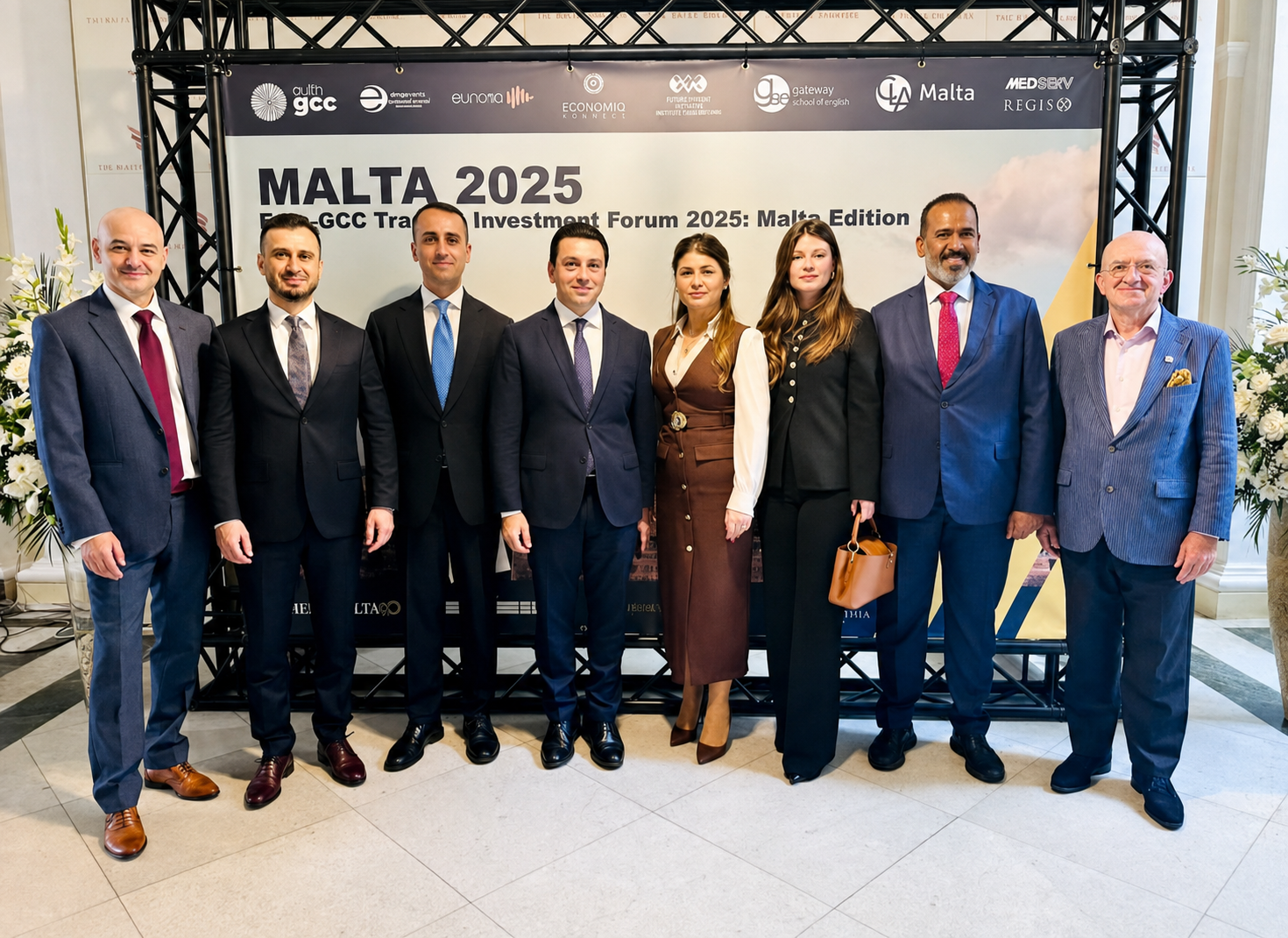
And there remains the structural gap a European observer notices, made more acute by the crisis. The relationship is strong at the top (summits, sovereign funds, crisis diplomacy) and increasingly dense at the bottom, among individual firms and expatriate networks, but thin in the middle, where deals are actually assembled. Bloc-to-bloc diplomacy moves at the speed of 27 plus 6 governments, and those governments’ bandwidth is currently consumed by the war; companies still move at the speed of a signed contract. Bridging the two are dedicated platforms of economic diplomacy: chambers, business councils, and initiatives that convert political goodwill into pipelines of qualified counterparties. Newer vehicles such as the Euro-GCC Economic Platform, launched in Bucharest in late 2024 with its second business summit hosted in Malta in October 2025, are worth watching precisely because of their geography: Central Europe and the Mediterranean, parts of the EU that see the Gulf not as a former periphery but as a peer. In a year when governments are triaging crises, this intermediary layer is where the €165 billion relationship either compounds or stagnates.
What that intermediary work looks like in practice is specific rather than ceremonial. The Euro-GCC Economic Platform operates as an economic diplomacy and business acceleration vehicle: a member firm moves from defined objectives to a tailored roadmap and then to execution, in the form of structured introductions and working meetings with Gulf government and business leaders rather than conference networking. Its cadence, from the launch conference in Bucharest in November 2024 to the second business summit at the Malta Chamber in October 2025, now runs into the season of the Riyadh summit. With official channels absorbed by ceasefire diplomacy and energy logistics, vehicles of this kind carry a disproportionate share of the relationship's forward motion: they are where the transactions a summit is expected to showcase are actually assembled.
The second EU-GCC summit, scheduled to take place in Riyadh this autumn, was always going to be the measure; the war has rewritten what it must measure. The first summit produced the architecture. The second must produce resilience as well as transactions. The checkpoints are identifiable: a durable transit regime for Hormuz emerging from the Omani-mediated talks; restored security at the Bab al-Mandeb and the approaches to Suez; conclusion of, or decisive progress on, the EU-UAE agreement; the first year of CBAM’s definitive regime and the way Gulf exporters prepare for its first financial settlement; IMEC segments with financing actually attached; the resumption of binding hydrogen and clean energy frameworks; jointly financed infrastructure (pipelines,interconnections, storage) that makes the next choke point crisis survivable; and the first investments assembled through the new intermediary platforms. Not all of this depends on Brussels and Riyadh alone; the first two items, in particular, depend on a diplomacy still in motion as this is written.
The European perspective, stripped of diplomatic varnish, is this: before 28February, Europe was learning in the abstract that it could no longer assume the Gulf needed it more than it needed the Gulf. The war made the lesson empirical. Europe has paid roughly €25 billion in additional energy costs for a conflict at choke points it does not control; the Gulf has absorbed strikes on its own soil while keeping its economies open and much of its capital deployed. Each side has now seen, priced in euros and in physical damage, what the other’s absence would cost. Interdependence between peers is more durable than dependence between unequals; the war has converted that proposition from argument into evidence. What remains is the unglamorous part: financing the redundancy that turns the next closure of a strait from a €25 billion bill into an inconvenience. That is the test Riyadh inherits.
%20(1).svg)
